Dachau concentration camp
The Book ThiefDachau concentration camp functions in the narrative as both a real destination and a looming moral geography. It lies beyond the Amper River, in the direction traced by the water past Molching, but its significance reaches into the town before its prisoners do. The camp is associated with Nazi power, forced labor, secrecy, public display, and the human cost of identities imposed by the regime. When the prisoners are marched through Molching, Dachau ceases to be an abstract place and becomes a road of visible bodies, exhausted movement, and ethical choice.
Setting and Political Meaning
Dachau concentration camp first enters the local landscape through the Amper River. As Hans Hubermann and Liesel sit near a wooden-planked bridge, the river is described as flanking the town and working its way past in the direction of Dachau. The geographical reference quietly joins ordinary domestic life to the machinery of persecution: after delivering ironing, Liesel and Hans write words in the grass, read them aloud, and listen to Hans play the accordion, while the river carries the imagination toward a concentration camp.
The camp also belongs to a political system that classifies people before it destroys them. Liesel cannot remember her father, but she knows that he was labeled a communist, a word she does not understand. Later, the deaths of her brother and the suffering of her mother join that label, a large bonfire, and the Führer in her growing attempt to understand the world. Dachau therefore stands within a chain of ideological categories and consequences: the regime’s language turns persons into enemies, while the camp gives that language a physical destination.
The Camp as Rumor and Threat
Dachau is not initially encountered directly. Liesel calculates that only four more reading sessions remain with Frau Holtzapfel before Jews are marched through Molching, and she understands where they are being taken: to Dachau, “to concentrate.” The calculation gives the camp an ominous temporal shape. Two weeks separate an ordinary routine from the approaching procession, making the camp present even before it can be seen.
The narrative emphasizes the contradiction between concealment and display. The death camps may have been kept secret, yet people were sometimes shown the supposed glory of a labor camp like Dachau. This tension exposes the regime’s control over knowledge: Dachau is hidden as a site of death but displayed as an instrument of labor and order. Its public image depends on euphemism, while the prisoners’ bodies reveal what the official description suppresses.
The Prisoner March Through Molching
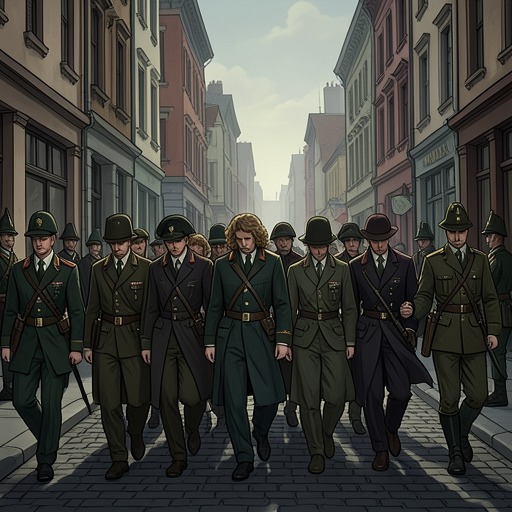
When the Jews are marched through the outskirts of Munich and toward Molching, Dachau becomes the endpoint of a forced journey. The prisoners are driven on foot, and the reason for the movement remains uncertain: perhaps more work is needed in the camp, or perhaps prisoners have died. That uncertainty does not lessen the horror; it shows how completely the prisoners’ lives have been absorbed into an administrative process in which labor, death, and replacement are treated as interchangeable possibilities.
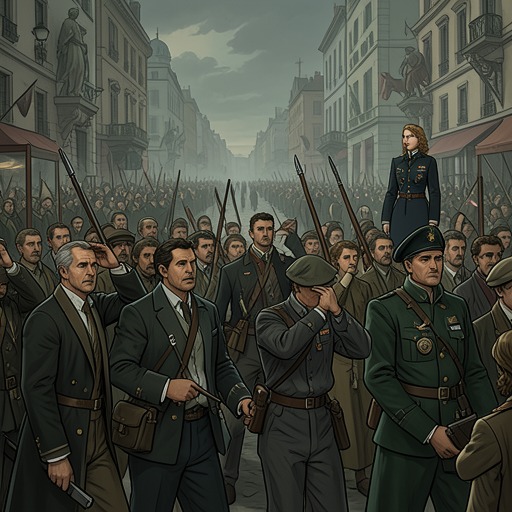
On Munich Street, Liesel and Rudy Steiner join the onlookers. The prisoners move down the road as a “catalog of colors,” but the image is not decorative. The narrator immediately connects the procession to their deaths, describing starving skulls, enormous eyes, dirt molded to the body, staggered legs, and soldiers’ hands forcing the prisoners into brief, wayward runs before they collapse back into malnourished walking. Dachau is thus represented not through its buildings or procedures but through the degradation carried along the road toward it.
Hans watches above the crowd, and Liesel looks through gaps between shoulders. The spectatorship matters: the camp’s violence is made visible to civilians, yet the crowd’s presence does not make the prisoners safe. Public witnessing exists alongside public powerlessness, fear, and complicity. Dachau’s reach extends beyond its gates into the behavior of those who watch, remain silent, or choose to act.
Consequences and Narrative Significance
The march forces Liesel to confront the relationship between private affection and public identity. The Nazi system separates Germans from Jews, marks Jewish bodies, and treats communist association as a dangerous label. Yet the narrative repeatedly places these imposed categories beside personal bonds. Alex Steiner is a member of the Nazi Party but does not hate Jews or anyone else; Max Vandenburg and Walter Kugler, once opponents in repeated fights, become genuine friends before anti-Jewish laws and employment discrimination reorganize their lives. Dachau represents the violent limit of a political order that refuses such individual relationships.
Its presence also foreshadows the choices made by Liesel and Hans. The camp is named before the prisoners appear, allowing dread to accumulate through repetition: the river points toward it, reading sessions count down to the march, and the town gathers when the road finally delivers its victims. A warm morning can become “another beautiful day for a parade,” an ordinary brightness set against the prisoners’ exhaustion. The contrast makes Dachau a central measure of the book’s moral world: beauty and routine continue, but they cannot remain innocent once the road to the camp passes directly through the town.
For Liesel, Dachau is ultimately the place toward which the narrative’s political knowledge converges. The word communist, the Führer, anti-Jewish laws, and the starving procession are not isolated facts; they form a structure in which labels become exclusions and exclusions become bodily suffering. By making Dachau both a distant direction and a visible road, the narrative shows how persecution can appear remote in geography while already shaping every household, friendship, reading lesson, and act of witnessing in its path.